Capping the Peerage: The Lords Reform Westminster Could Actually Deliver
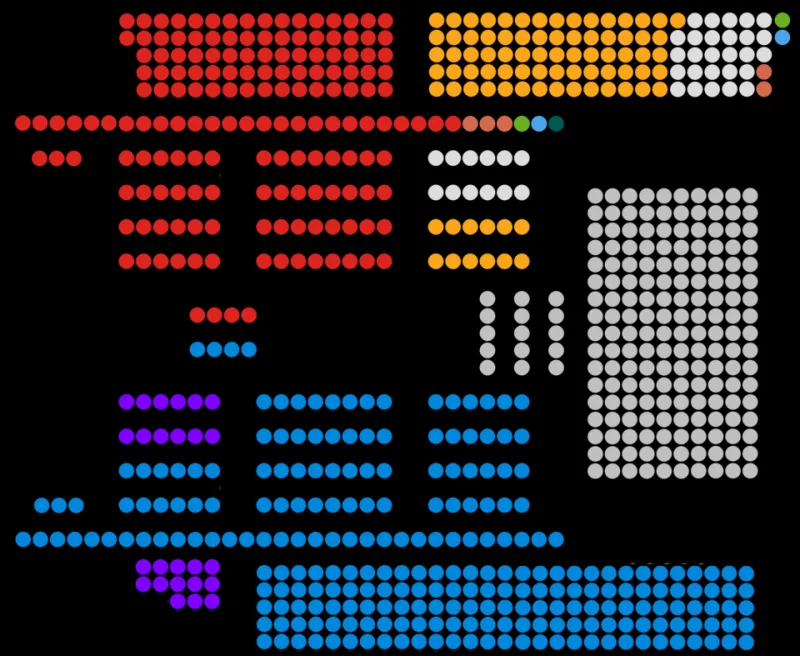
Photo: Radixsaurus95, CC0, via Wikimedia Commons
The House of Lords is now the second largest legislative chamber in the world, and the only one of that size whose membership grows by ministerial signature. Successive prime ministers have added peers at a rate that no retirement scheme or natural wastage can offset. The result is a chamber that is expensive to run, physically crowded at peak attendance, and difficult to defend in the language of economy and accountability that centre-right politics prefers.
Yet the case for reform is not the case for reconstruction. The temptation, whenever the upper house is discussed, is to reach immediately for the large constitutional settlement: an elected senate, a written composition, a new concordat with the Commons. That route has failed repeatedly — in 1911, in 1949, in 1969, in 1999 and again in 2012 — because it requires agreement on a design question no party has ever settled internally, let alone across the floor. There is a shorter road, and it is worth taking.
What has actually gone wrong
Three things, none of them fatal in isolation.
First, size. Membership has climbed towards eight hundred, having been roughly halved in 1999 on the promise that the transitional house would not be permanent. Every dissolution honours list adds to the total; the removal of the remaining hereditary peers under the 2025 Act will reduce it, but not durably.
Second, cost and attendance. The chamber's running costs are comfortably north of one hundred million pounds a year, and the payroll of allowances grows with each intake. Yet average daily attendance sits far below the total membership — a large minority of peers draw allowances while rarely contributing to the work of scrutiny. That is not corruption; it is a design flaw. Life membership with no obligation to attend produces exactly the pattern one would predict.
Third, appointments. The Lords Appointments Commission vets nominees for propriety, not for merit, and has no power to consider whether the House actually needs another peer. Prime ministers of both parties have used the list as an instrument of patronage. The public understands this, and it corrodes the standing of a chamber whose substantive work — the detailed revision of legislation, the scrutiny of statutory instruments, the expertise on subjects the Commons never has time for — is genuinely valuable.
A cap, a threshold and a committee
A statutory ceiling
A statutory cap on membership is the single most useful measure available. Parity with the Commons — six hundred and fifty — has the advantage of being explicable in one sentence, though any figure between five hundred and six hundred and fifty would do the job. The mechanism matters more than the number. A transitional rule of two departures for every new appointment would reduce the House steadily without a mass expulsion or a single divisive vote on individuals.
Crucially, the cap must bind the prime minister, not merely guide him. A ceiling written into statute, with appointments beyond it void, converts a matter of self-restraint into a matter of law.
An attendance threshold
Second, a working attendance threshold. The Lords already permits voluntary retirement and leave of absence; the next step is to make continued membership conditional on participation. A peer who attends fewer than a defined number of sittings across a full session — with sensible exemptions for ministers, officeholders and the seriously ill — should lose the right to sit, subject to a formal resolution and a right of reply. This is not a purge. It is the minimum condition of any legislature that its members turn up.
A transparent appointments committee
Third, put the appointments process on a statutory footing. The commission should be given a duty to report publicly on the size, balance and skills of the House before each list is submitted, and the power to refuse a nominee who would take the House beyond its statutory ceiling. Pre-appointment hearings, conducted with the civility that the Commons sometimes struggles to maintain, would do more for public confidence than any reorganisation of the benches. The committee should also be required to publish the criteria it applies, including the balance between political and crossbench appointments.
What this is not
The objection from the constitutional purist is that piecemeal reform entrenches the status quo. That risk is real, but it is the lesser one. A capped, attendance-tested house of several hundred active members is not a permanent settlement; it is a better starting point for whatever settlement eventually arrives. What it avoids is the creation of an elected chamber with its own mandate, competing with the Commons for legitimacy on tax, spending and the confidence of the Crown. The upper house's value lies precisely in its lack of an electoral mandate: it can revise, delay and embarrass, but it cannot claim to speak for the country. Conservatives should be wary of any reform that confers that claim.
Nor should the cap be presented as an act of hostility to the chamber. The Lords' scrutiny of delegated legislation is, as this site has argued, an underused constitutional asset; a smaller, more engaged house would do that work better, not worse.
The politics of the possible
The recent removal of the hereditary peers is instructive. It succeeded not because there was consensus on the future of the second chamber, but because the measure was narrow, legible and defensible in principle. A membership cap, an attendance threshold and a statutory appointments committee sit in the same category. They require no referendum, no boundary review and no new electoral system. They could be carried through the ordinary legislative process, and a determined Commons could, after the usual delay, use the Parliament Acts to overcome resistance — though any government that had to do so over the composition of the upper house would have failed politically long before it succeeded constitutionally.
Reformers should resist the temptation to bundle these measures with a grander scheme, because bundling is how the last century of Lords reform was lost. Take the three steps that can be taken. The House would be smaller, cheaper and harder to mock — and the constitution would be stronger for a reform that asked only that it work.